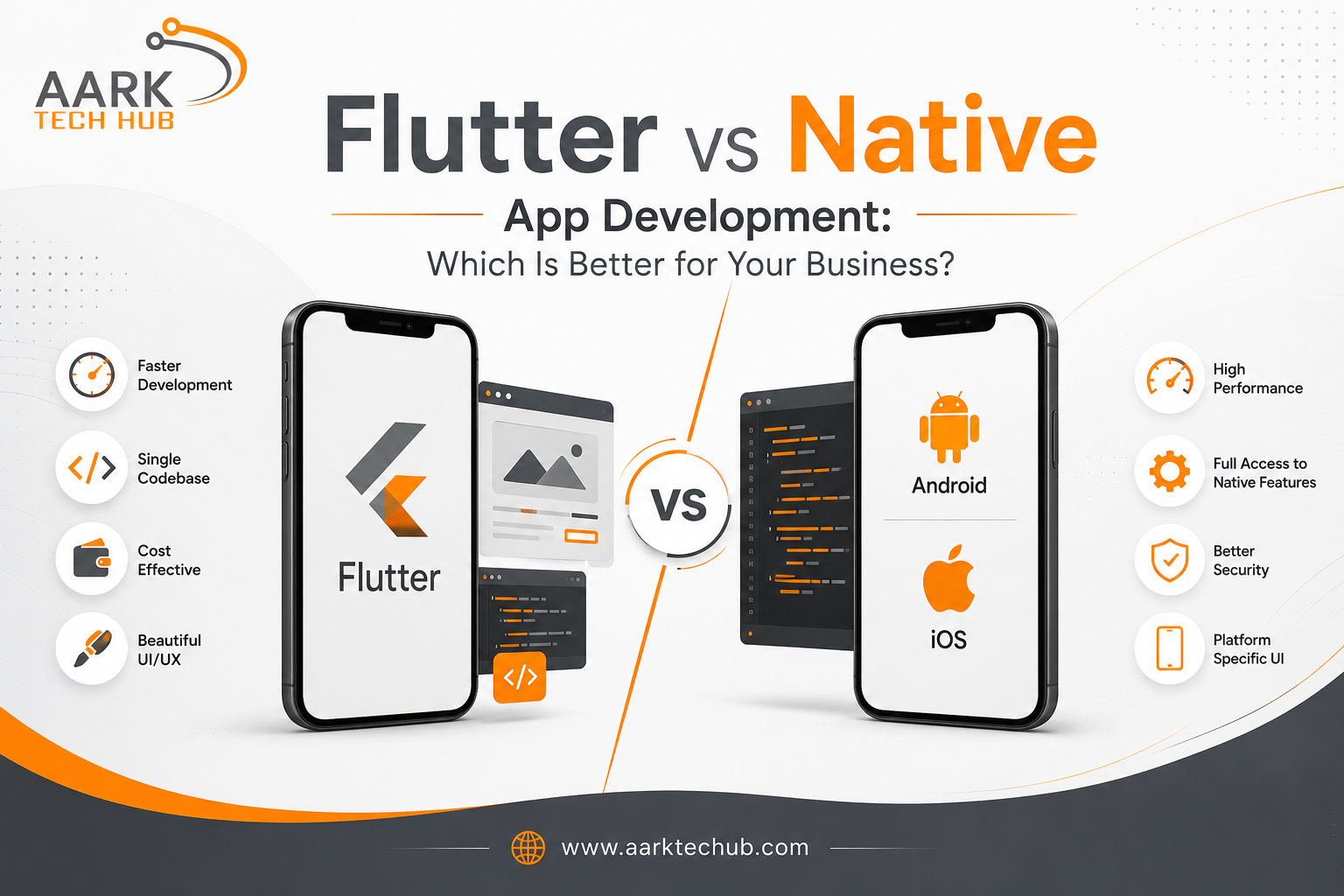
Choosing the right technology for a mobile app can be challenging, especially when you have to decide between Flutter and native app development. Both approaches can help businesses build high-quality mobile applications, but they differ in development time, cost, performance, scalability, and maintenance.
For startups, MSMEs, and established businesses, the right choice depends on the app's requirements, target audience, budget, and long-term goals. In this guide, we will compare Flutter vs native app development and help you understand which option may be better for your business.
What Is Flutter App Development?
Flutter is an open-source UI framework developed by Google. It allows developers to create applications for multiple platforms, including Android, iOS, web, and desktop, using a single codebase.
Flutter app uses the Dart programming language and provides a rich collection of customizable widgets. Businesses can use Flutter to develop modern applications while reducing development time and effort.
One of the biggest advantages of Flutter is that developers do not always need to maintain completely separate codebases for Android and iOS.
What Is Native App Development?
Native app development means creating applications specifically for a particular operating system.
For example:
Android apps are commonly developed using Kotlin or Java.
iOS apps are commonly developed using Swift or Objective-C.
Since native applications are designed specifically for their target platform, developers can access platform-specific APIs and features directly.
Native development is often preferred for applications that require advanced device capabilities, intensive processing, or highly optimized platform-specific experiences.
Flutter vs Native: Key Differences
1. Development Time
Flutter can significantly simplify development because the same codebase can be used across Android and iOS.
With native development, separate development efforts are generally required for each platform. This can increase development time, particularly when an app needs to launch on both Android and iOS.
Winner: Flutter
For businesses looking to launch an MVP or cross-platform application quickly, Flutter can be a practical option.
2. Development Cost
Development cost depends on the application's complexity, features, design, integrations, and development team. However, Flutter can reduce costs when Android and iOS applications are required because much of the code can be shared.
Native development may require separate teams or development resources for different platforms.
Winner: Flutter
For startups and small businesses with limited budgets, cross-platform development can provide better cost efficiency.
3. App Performance
Native applications generally offer excellent performance because they are built specifically for their operating system and can communicate directly with native APIs.
Flutter applications can also provide strong performance and are suitable for many business applications, e-commerce platforms, booking systems, social apps, and other modern mobile solutions.
However, for extremely performance-intensive applications, such as certain advanced games or applications requiring extensive platform-specific processing, native development may have an advantage.
Winner: Native
4. User Interface and Design
Flutter provides a powerful widget-based system that allows developers to create customized and visually consistent interfaces across platforms.
Native development provides access to platform-specific UI components and conventions, which can be useful when an application needs to closely follow Android or iOS design standards.
Winner: Depends on requirements
If you want a consistent design across platforms, Flutter is attractive. If you want a highly platform-specific interface, native development may be preferable.
5. Maintenance and Updates
Maintaining one shared codebase can make Flutter applications easier to manage in many cross-platform projects.
Developers can implement common changes and improvements across platforms without maintaining completely separate implementations for every feature.
Native applications may require platform-specific updates, which can increase maintenance work when both Android and iOS versions are involved.
Winner: Flutter
When Should Your Business Choose Flutter?
Flutter can be a strong choice when your business needs:
Android and iOS applications
Faster development
A controlled development budget
Consistent UI across platforms
MVP or startup applications
E-commerce applications
Booking and service applications
Business management applications
Social networking applications
Applications requiring regular feature updates
For many businesses, Flutter provides a good balance between development speed, cost, design flexibility, and performance.
When Should You Choose Native App Development?
Native development can make more sense when your application requires:
Extremely high performance
Complex device-level functionality
Advanced graphics
Extensive platform-specific APIs
Highly customized Android or iOS experiences
Specialized hardware integration
Maximum platform-specific optimization
For example, applications that rely heavily on advanced camera features, Bluetooth communication, AR capabilities, intensive graphics, or other platform-specific technologies may benefit from native development.
Flutter vs Native: Which Is Better for Your Business?
There is no single answer for every business.
If your primary goal is to build an Android and iOS application efficiently while controlling development costs, Flutter can be an excellent choice. Its shared codebase can help reduce duplication and simplify development.
On the other hand, if your application requires maximum platform-specific performance and deep integration with native device capabilities, native development may be the better solution.
The decision should be based on your application's features rather than simply choosing the most popular technology.
Why Choosing the Right Development Partner Matters
Technology is only one part of successful app development. The experience of your development team also plays an important role.
A professional mobile app development company can analyze your business requirements, recommend the appropriate technology, design the application architecture, develop the product, test it across devices, and provide ongoing maintenance.
At AARK Tech Hub, businesses can explore customized app development solutions based on their requirements, target platforms, and long-term goals.
Final Thoughts
Both Flutter and native app development have their own strengths. Flutter is particularly attractive for businesses looking for cross-platform development, faster development cycles, consistent design, and cost efficiency. Native development remains a strong option when maximum platform-specific performance and functionality are the priority.
Before making a decision, consider your budget, target platforms, app complexity, performance requirements, development timeline, and future scalability.